
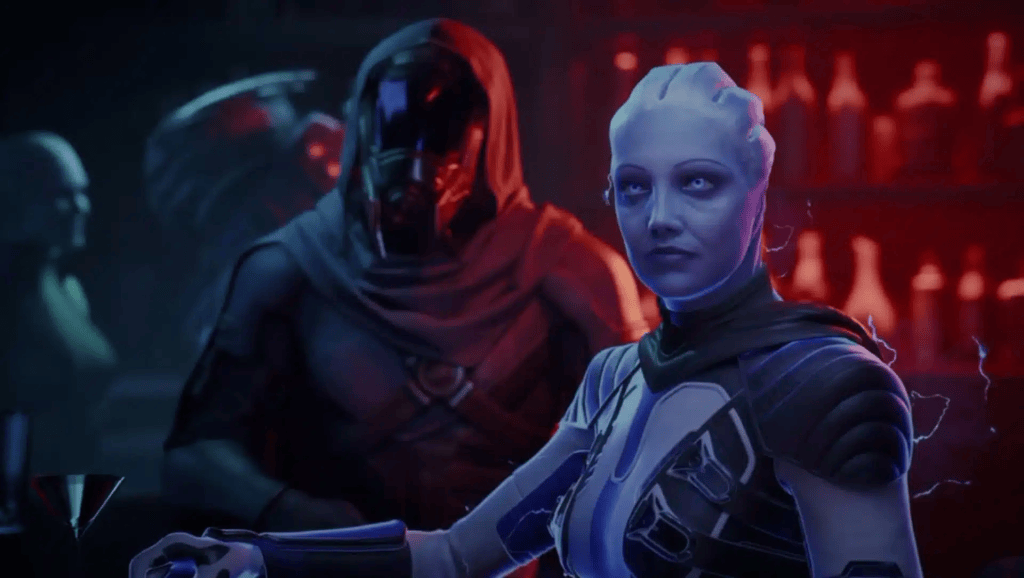
As EA’s New Owners Pivot to Sports, What Happens to Its Legendary RPG Franchises?
For decades, Mass Effect and Dragon Age were a rarity in the modern games industry: big-budget, story-driven RPGs that put characters, world-building, and player choice ahead of recurring revenue. They were BioWare’s crown jewels and among the most beloved franchises EA ever owned.
Now their future has never looked more uncertain.
After EA’s $55 billion, Saudi-backed buyout led by the Public Investment Fund (PIF), Silver Lake, and Affinity Partners, the publisher appears to be concentrating resources on its safest, most reliably profitable businesses. Recent restructuring points to a sharpened focus on sports titles, live-service games, and proven blockbusters.
The closure of BioWare and cancellation of the next Mass Effect have come to symbolize this shift. EA has reportedly redirected investment toward franchises such as EA Sports FC, Madden, Battlefield, and Apex Legends. And at the beginning of this week, it announced the return of the Fight Night series.
Is there room for Mass Effect and Dragon Age to fit in EA’s future at all?
The Economics Are Hard to Ignore
Sports games generate steady annual revenue on predictable schedules. Live-service titles create recurring spending through battle passes, cosmetics, and seasonal content. Investors prize that kind of reliability.
Traditional single-player RPGs are the opposite.
A modern AAA RPG can take five to seven years, hundreds of developers, and a budget bordering on blockbuster film territory. One disappointing launch can wipe out years of investment.
That appears to be what happened with Dragon Age: The Veilguard. Reports suggest the game attracted roughly 1.5 million players, well below company expectations.
For a publisher now carrying billions in acquisition-related debt and intent on cutting costs, franchises that demand huge budgets with uncertain returns become hard to justify.
In that environment, a new Mass Effect looks less like an opportunity and more like a liability.
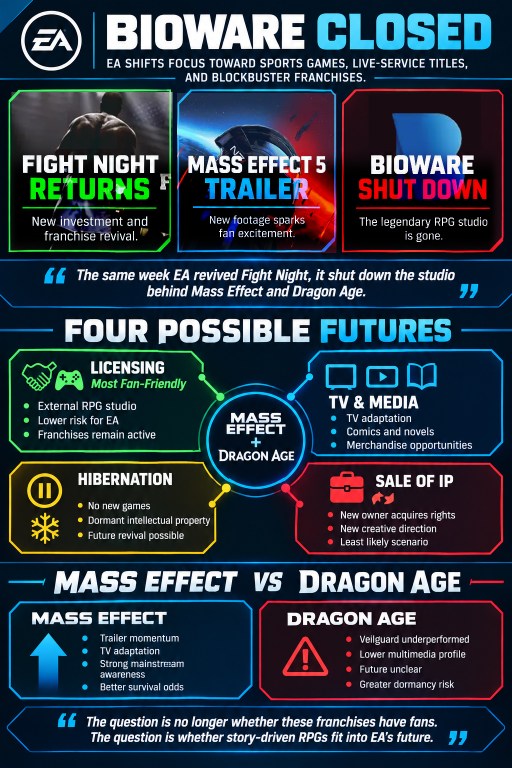
Option One: Put the Franchises on Ice
The most likely short-term outcome is also the least exciting. EA could simply do nothing.
Publishers routinely shelve intellectual property for years or even decades when conditions aren’t favorable. We’ve seen it with Dead Space, Command & Conquer, Need for Speed, and numerous other EA-owned series.
Under this strategy, Mass Effect and Dragon Age would remain valuable assets on paper while requiring almost no investment.
Given the current emphasis on cost-cutting and predictable returns, this may be the most likely path.
Option Two: License the Franchises to Outside Studios
A more intriguing possibility is licensing.
Instead of internally funding a massive RPG, EA could partner with external studios that specialize in narrative RPGs, with EA acting primarily as publisher rather than developer.
- Mass Effect developed by a studio with proven RPG experience such as Obsidian Entertainment.
- Dragon Age handled by Larian Studios.
- Both can be entrusted to either Archetype Entertainment or Reset Studios, companies founded by former BioWare developers.
This approach would reduce EA’s risk while keeping the franchises alive.
The modern games industry increasingly embraces outsourcing and co-development. For a publisher focused elsewhere, licensing could generate revenue without massive internal spending. To quote John Carpenter, “I sit on the couch, and a check arrives in my hand…”
Option Three: Expand Beyond Games
Ironically, Mass Effect may have greater near-term potential outside games.
Soon after the shutdown news, Amazon confirmed its ordered Mass Effect TV series is still in development. The universe is tailor-made for television and streaming: political intrigue, alien civilizations, military conflicts, and dense lore—exactly the kind of large-scale science fiction platforms keep chasing.
Even if the games stay dormant, EA could still extract value through:
- Television adaptations
- Animated projects
- Novels
- Comics
- Cookbooks
- Merchandise
- Licensing agreements
Many entertainment companies now treat IP as multi-platform brands rather than standalone games.
In that scenario, Mass Effect becomes less a video game franchise and more a broad science-fiction media property.
Option Four: Sell the IP Entirely
A publisher doesn’t spend billions acquiring a company only to immediately sell off its best-known franchises. Still, it’s not impossible.
If EA’s new owners become intensely focused on sports, a future sale of dormant franchises could eventually make financial sense as a way to pay down inherited debt. A company built around RPGs might see far more value in Mass Effect or Dragon Age than a sports-centric publisher ever could. Earlier, Larian was mentioned as a potential licensee, but what if it bought the series outright?
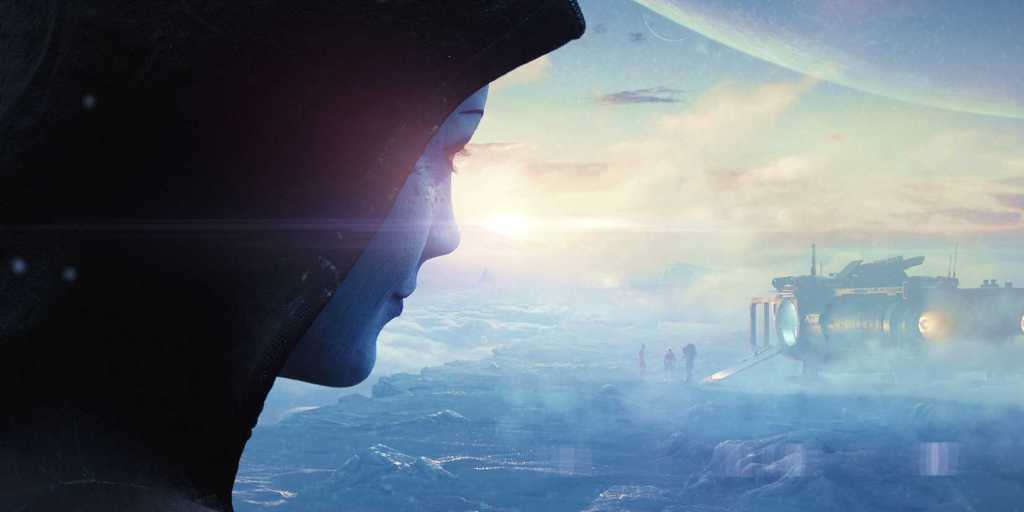
This option picked up momentum since a trailer to Mass Effect 5 leaked the night the shutdown was announced. It helped invigorate the idea of the series being sold or licensed to another studio to develop.
Ideas of XBOX buying Mass Effect are being floated around but more companies might be curious to purchase the franchise because of the leaked trailer.
The problem is that franchises like these derive much of their worth from brand recognition and future potential. Selling them creates a one-time payday; keeping them preserves long-term optionality. Most investors favor optionality unless they view the asset as toxic and in need of being sold off to prevent greater losses.
The likely Fate of Dragon Age
Much of the conversation has centered on Mass Effect. Between Amazon’s television adaptation and the recent Mass Effect 5 trailer leak, the franchise remains firmly in the public eye. Dragon Age, however, may face a far bleaker future.

Even during BioWare’s peak years, EA often appeared to view Mass Effect as the studio’s premier franchise. While both series enjoyed critical and commercial success, Mass Effect consistently received more attention as a multimedia property and broader entertainment brand.
Dragon Age also carries the burden of Dragon Age: The Veilguard, whose underwhelming performance damaged confidence in the franchise at a time when EA was already reassessing its portfolio. While Dragon Age has expanded into novels, comics, direct-to-video movies, a cookbook and those efforts never elevated the series to the same level of mainstream recognition enjoyed by Mass Effect.
If EA’s previous leadership was unconvinced that Dragon Age could become a major growth franchise, there is little reason to believe the company’s new sports-focused ownership group will see the property differently. While Mass Effect may survive through television, licensing, or a future revival, Dragon Age risks becoming the first casualty of EA’s changing priorities: a beloved fantasy universe left dormant while resources are directed toward brands with clearer commercial upside.
The Real Tragedy
The biggest loss isn’t just another canceled game. It’s the disappearance of a development philosophy.
BioWare helped define an era when major publishers saw large single-player RPGs as prestige projects. Games like Mass Effect 2, Dragon Age: Origins, and Knights of the Old Republic weren’t built around engagement metrics or monetization funnels. They were built around storytelling.
Today’s industry rewards a different model. Recurring revenue beats critical acclaim. Predictability beats experimentation. Sports games beat role-playing games.
That doesn’t mean story-driven RPGs are dead successes like Baldur’s Gate 3 prove there’s still enormous demand. But publishers now expect those games to justify themselves with exceptional financial results. Good reviews are no longer enough.
Final Verdict
If EA’s future truly revolves around sports, live services, and evergreen franchises, Mass Effect and Dragon Age may become relics of an earlier era. The most likely outcome is a long hibernation. The most hopeful is licensing or revival under a new team. The most dramatic is an eventual sale.
Whatever happens, one thing seems clear: these franchises are too valuable and too beloved to vanish forever.
The real question isn’t whether Mass Effect and Dragon Age will return.
It is a question of whether the industry that can still reach that high, or if its best work now lies behind it.



Leave a Reply